
Articles
Return To Full List of Articles
Rachel Carson: Witness for Natureby Linda Lear (Allen Lane) |
Times Books, 19th March 1998 |
Each generation has its visionaries - those with the gift of prophesy who may be doomed to mockery and disbelief. Such was not quite the fate of Rachel Carson, although she suffered her share of dismissive sexism, and is perhaps not known and honoured enough within the ranks of new-generation environmentalists. Linda Lear's timely and definitive biography will certainly introduce a new readership to the magnificent achievement of Silent Spring - the work that did more than any previous book (and maybe even since) to waken and alarm the world to the permanent damage done when shortsighted and rapacious humanity deliberately pollutes the planet.
Born in Springfield, Mass. in 1907, Rachel Carson learned at her mother’s knee a love of landscape and all its inhabitants, however tiny, that transcended mere enjoyment. They shared a Wordsworthian sense of nature as a moral force, before which there is no choice but to learn and be humble. Carson’s early world was to be ruined by industrial pollution which nevertheless brought much-needed jobs, and although the memoryof the smokestacks and ugliness would remain with her forever she was always aware that passion must needs be tempered by a degree of pragmatism.
Her first ambitions were literary, and all through her life she would craft sentences with an ear finely attuned to the poetry of language, even within scientific discourse. But a beloved and gifted science teacher at Pennsylvania College for Women was to change her life. By 1928 Carson was planning a career in science, and her early obervation of nature had broadened into ecological consciousness.
Rachel Carson’s efforts to become a marine biologist at a time when female scientists were not welcome within the academic community, and subsequent success as a government scientist in the Fish and Wildlife Service, are fascinating in themselves, but the real drive of Lear’s narrative is in Carson’s development of insights and ideas that were before their time. In 1936, for example, she wrote a densely researched article which concluded that the decline in numbers of a certain fish was ‘probably the result of destructive methods of fishing, the pollution of waters by industrial and civic wastes...’ She warned that if the shad were to survive, ‘regulations must be imposed which consider the welfare of the fish as well as that of the fisherman’. Her life’s work, which was to illuminate the effects of human intrusion on nature whilst doing everything possible to instil a respect for its intricate processes, had begun.
By 1945, chief breadwinner for a complicated and difficult family yet longing to leave the government service, Carson knew that her future must lie in science writing for the lay audience, a means by which she could also express her inner vision. A moving passage from her first book, Under The Sea Wind (1941) Carson shows the lyrical influence of Richard Jefferies:
To stand at the edge of the sea, to sense the ebb and flow of the tides, to feel the breath of a mist moving over a great salt marsh, to watch the flight of shore birds that have swept up and down the surf lines of the continents for untold thousands of years, to see the running of old shad and young eels to the sea, is to have knowledge of things that are as nearly eternal
as any earthly life can be.
The runaway bestseller success of The Sea Around Us in 1951 testified to a craving in the American public (beset by growing fear of the arms race) for a larger dimension within which spirit and science could meet. Carson herself denied that her preoccupations were in any way escapist or unrealistic, pointing out that, 'the mysteries of living things, and the birth and death of continents and seas, are among the great realities'. In public and in private she toiled to make people understand the interdependence between the physical environment and the life it sustains.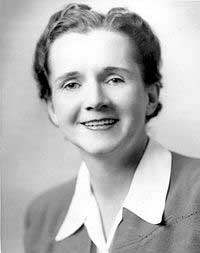
By the fifties Rachel Carson was already aware of the terrifyingly irresponsible use of DDT, which was being sprayed on fields and trees as part of the so-called 'war on insects', with no knowledge of its long-term effects. She became involved with the 'Great Cranberry Scandal' of 1959, when the bushes were drenched with a herbicide that turned out to be a carcinogen, and yet as Thanksgiving approached suspect fruits were shipped to market, whilst politicians ate handfuls in public to prove they were quite safe..... Sounds vaguely familiar? The depressing thing about reading Lear's excellent biography is the knowledge that nothing much has changed. Rachel Carson was in the front line of a battle which is still going on today, between those who regard mankind as humble custodians of the earth, and the rapacious ones who think only of today's returns.
When Silent Spring was published in 1962, Carson was already being consumed by the cancer that would end her life at the age of 57. The Velsicol Corporation, a huge pesticide manufacturer, tried to stop publication of her book. Not so long afterwards they polluted the entire Mississippi. Then the Monsanto Corporation, an industry leader in the development and manufacture of pesticides, responded to Silent Spring by distributing a mocking parody of Carson’s warnings to every newspaper in the USA. This same Monsanto is currently at the heart of the controversy over genetically-modified soya. You have only to glance at the pages of Farmers Weekly to realise that the ‘war against insects’ goes on, with indiscriminate napalm and slash tactics - which is why UK pesticides were worth £1.3 billion in 1994.
In Britain and American, then as now, the land is in thrall to the all-powerful agri-business (and its political apologists) which capitalises on avarice and ineptitude. Were she alive today, Rachel Carson would find much to make her rage, as well as weep. Two years ago, for example, Graham Harvey published The Killing of the Countryside (a book Carson would have been proud of) and described poisoned ditches, vanishing meadows, and fields stripped of flowers, butterflies, animals and birds. Silent Spring indeed.